
GlassClear Coat (FBq101)
Anti-soiling self-cleaning solution for glass curtain walls
Feibo glass self-cleaning coating uses nano photocatalytic and super-hydrophilic technology to form a transparent functional film on the glass.
Under sunlight and rain it keeps breaking down pollutants while a sheet of water carries dirt away, so the glass stays clean long term. It greatly reduces manual cleaning at height, cutting maintenance cost and safety risk and keeping building glass clear and clean for years.
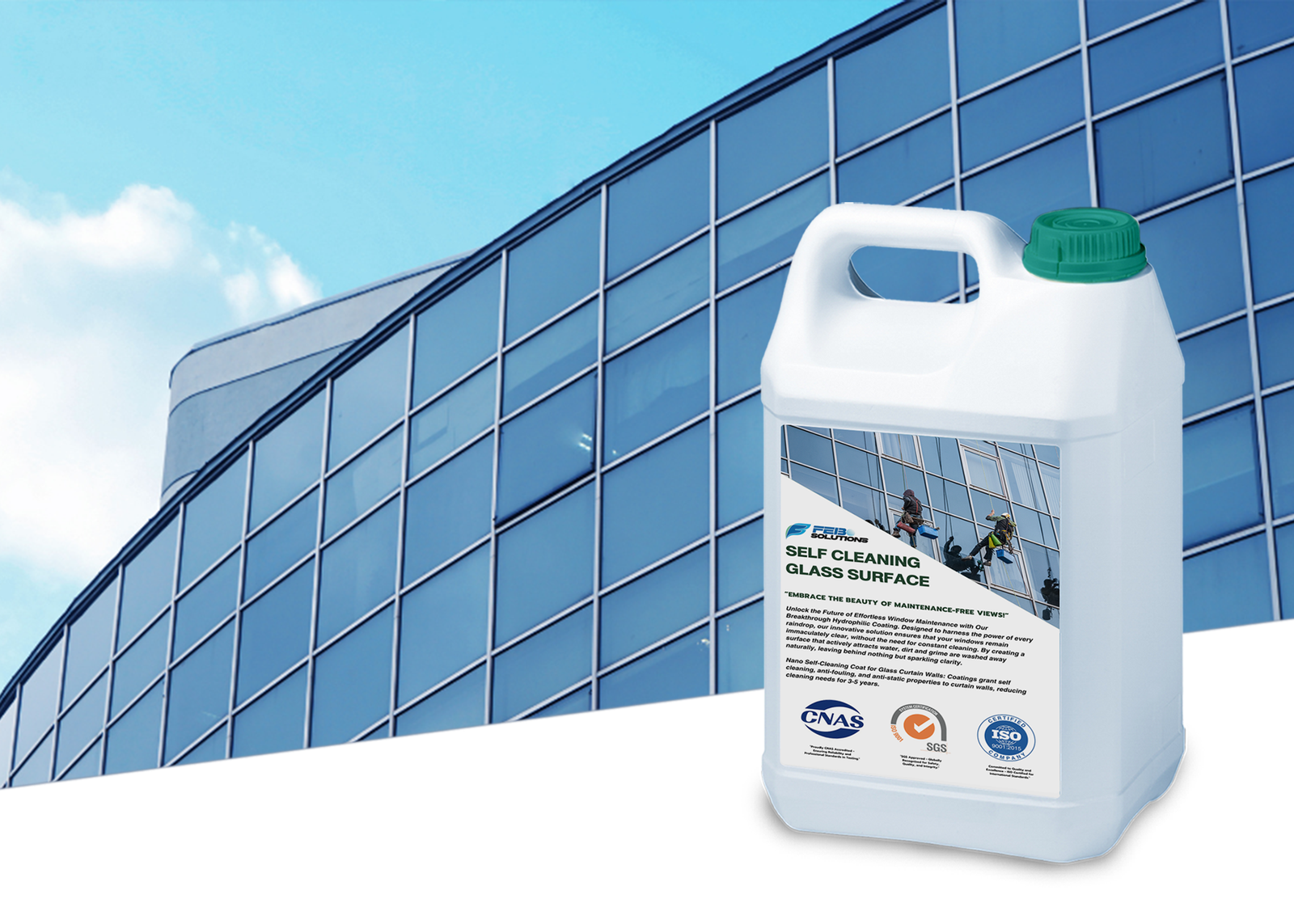
Glass self-cleaning coating liquid
Product features:
- Forms a nano-scale functional structure that greatly increases the hydrophilicity of the glass
- Ultra-thin transparent coating — no effect on the glass’s original light transmission or appearance
- Water contact angle ≤10°: rain sheets across the surface and washes dirt away
- Resists adhesion of oil, organic pollutants and water marks
- Anti-static: less dust and particle attraction
Functions:
Super-hydrophilic, self-cleaning, anti-soiling, anti-static
Typical uses:
Curtain-wall glass, skylights and glass on public facilities — lower cleaning frequency, long-term clarity
Main ingredients:
Silicon dioxide, silicates, inorganic oxides, functional resin
Functions and performance
Super-hydrophilic self-cleaning / anti-soiling
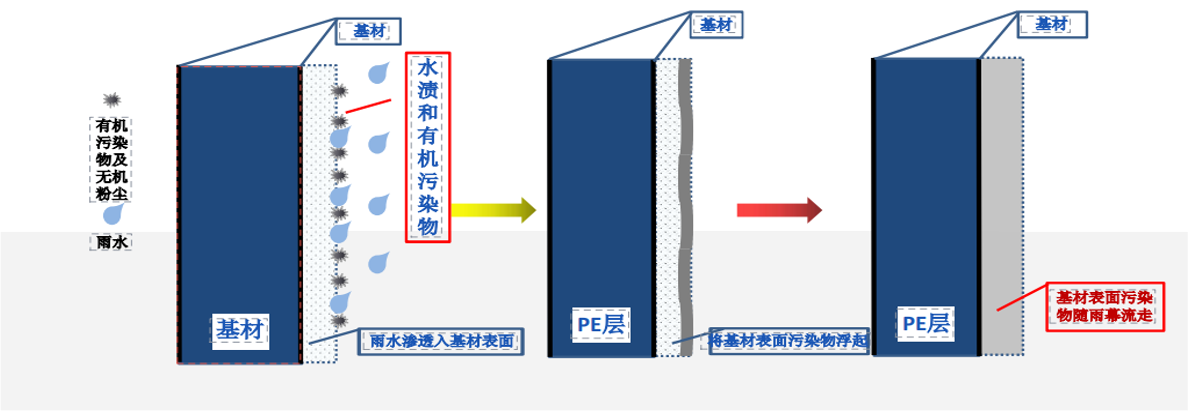
Super-hydrophilic self-cleaning: the coating sharply lowers the water contact angle of the glass, so rain spreads into a thin sheet that carries dust and pollutants away — natural self-cleaning.
Anti-soiling: resists adhesion of oil, organic pollutants and water marks, keeping the glass clean long term.
Anti-static, dust-repellent
Reduces electrostatic attraction, so less dust and fewer particles settle and the glass gets dirty more slowly.
High transmission, no change in appearance
An ultra-thin transparent coating that does not change the colour or clarity of the glass, meeting the visual requirements of building facades.
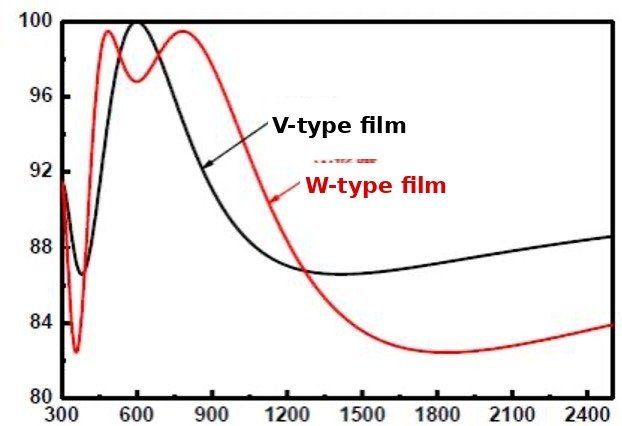
Light transmission — initial value
| Wavelength (nm) | Uncoated (%) | Coated (%) | Change |
|---|---|---|---|
| 1500 | 88.9 | 89.8 | 101% |
| 1000 | 86.6 | 88.5 | 102% |
| 900 | 86.9 | 89.1 | 102% |
| 800 | 87.7 | 90.3 | 103% |
| 700 | 89.4 | 92.5 | 103% |
| 600 | 90.5 | 94.2 | 104% |
| 500 | 90.7 | 94.7 | 104% |
| 400 | 90.0 | 93.0 | 103% |
| 340 | 88.2 | 90.7 | 102% |
Result: coated glass shows an average light-transmission gain of 2.5% over uncoated glass (340–1500 nm). Cause: the surface structure of the coating raises transmission after application.
Light transmission — after 4 months outdoor exposure
| Wavelength (nm) | Uncoated (%) | Coated (%) | Change |
|---|---|---|---|
| 1500 | 87.8 | 89.4 | 102% |
| 1000 | 85.3 | 88.3 | 104% |
| 900 | 85.2 | 88.9 | 104% |
| 800 | 85.8 | 90.0 | 104% |
| 700 | 86.7 | 91.3 | 106% |
| 600 | 87.1 | 92.9 | 107% |
| 500 | 86.0 | 92.4 | 107% |
| 400 | 82.8 | 88.8 | 107% |
| 340 | 65.0 | 69.3 | 107% |
Result: coated glass shows an average light-transmission gain of 4.4% over uncoated glass (340–1500 nm). Cause: the self-cleaning function keeps the coated glass at good transmission.
Ageing resistance
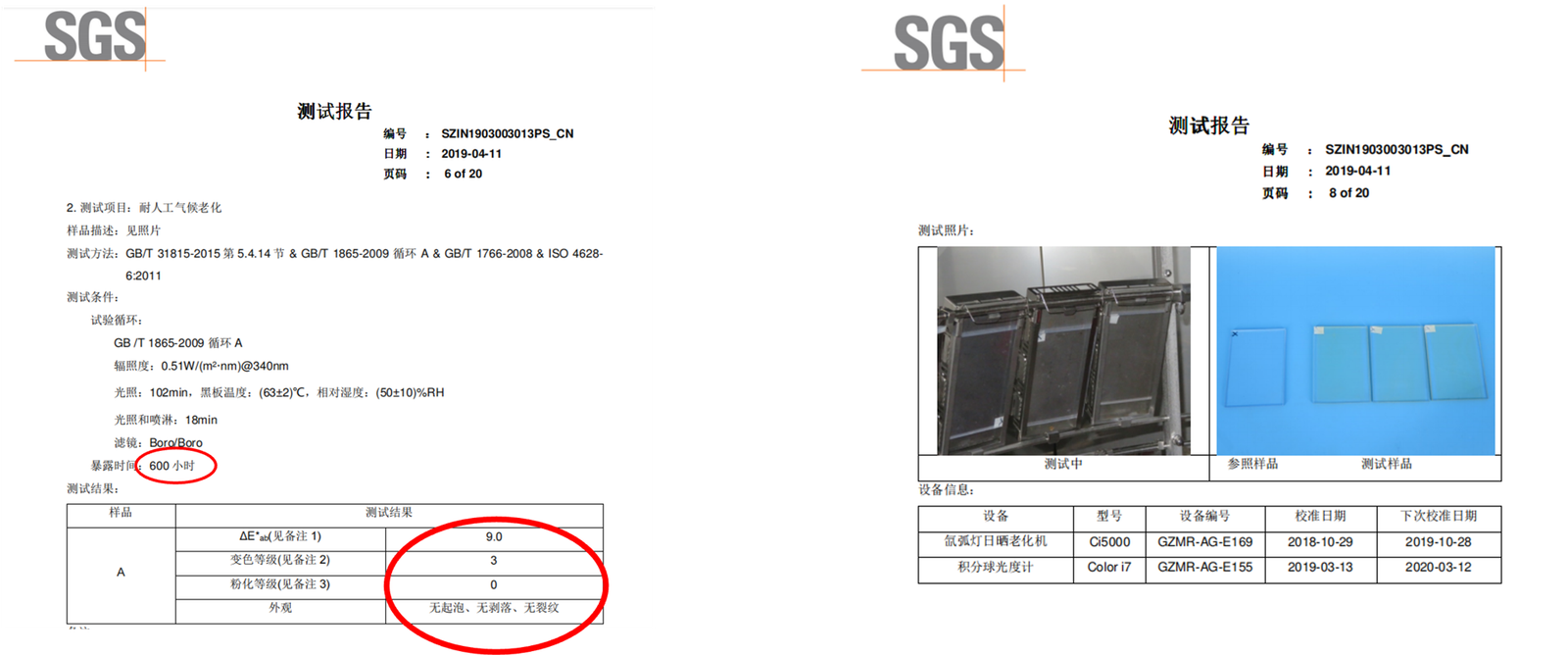
Outstanding ageing resistance: a 100% inorganic coating that is highly weather-resistant and does not degrade over the years. After 600 hours of accelerated ageing there was no chalking. In real outdoor use, with natural sand and wind wear, the coating’s high-efficiency period is five years, after which the effect fades slowly year by year.
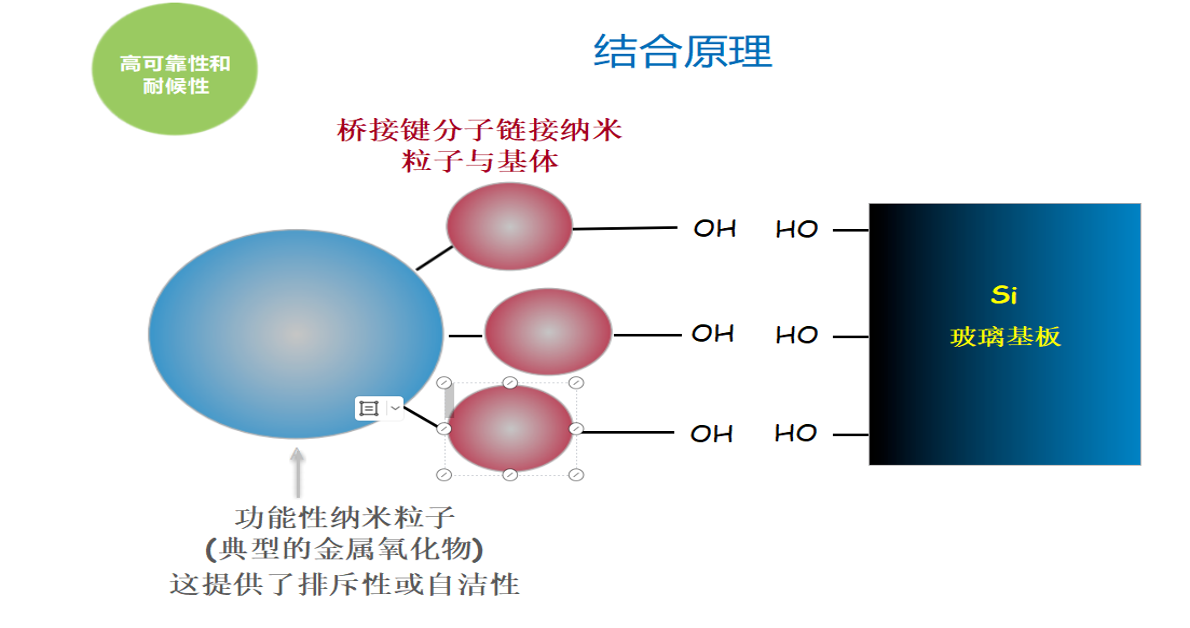
Non-polymerised monomers withstand much longer service.
Si–O bonds have a bond energy of 452 kJ/mol, second only to the F–H bond of fluorocarbon coatings (565 kJ/mol) — and fluorocarbon coatings already carry warranties of 20+ years.
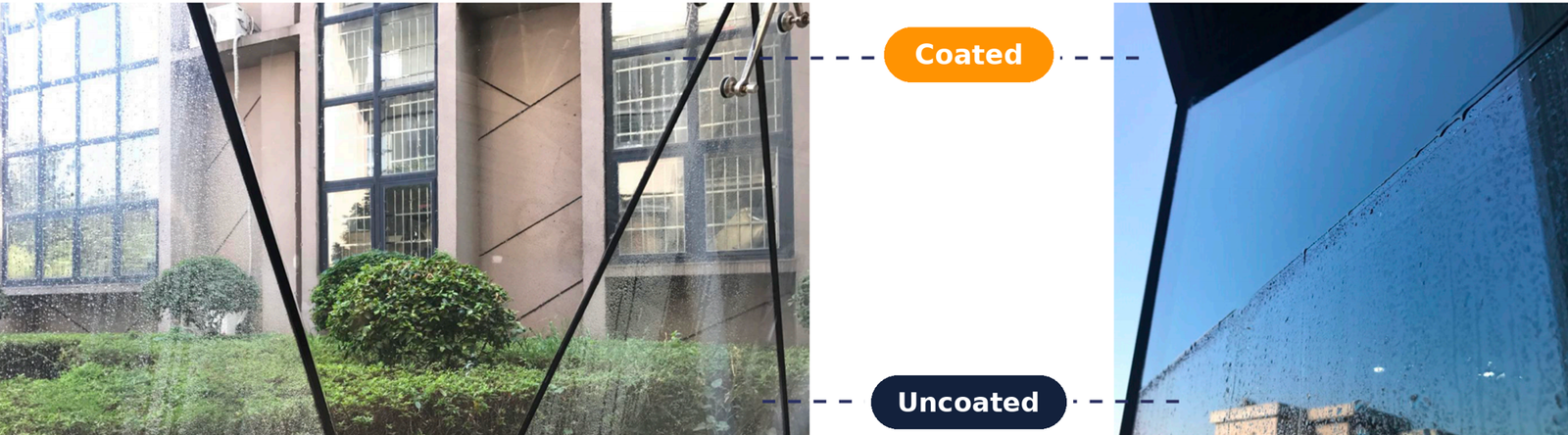
Glass self-cleaning coating: on-site results
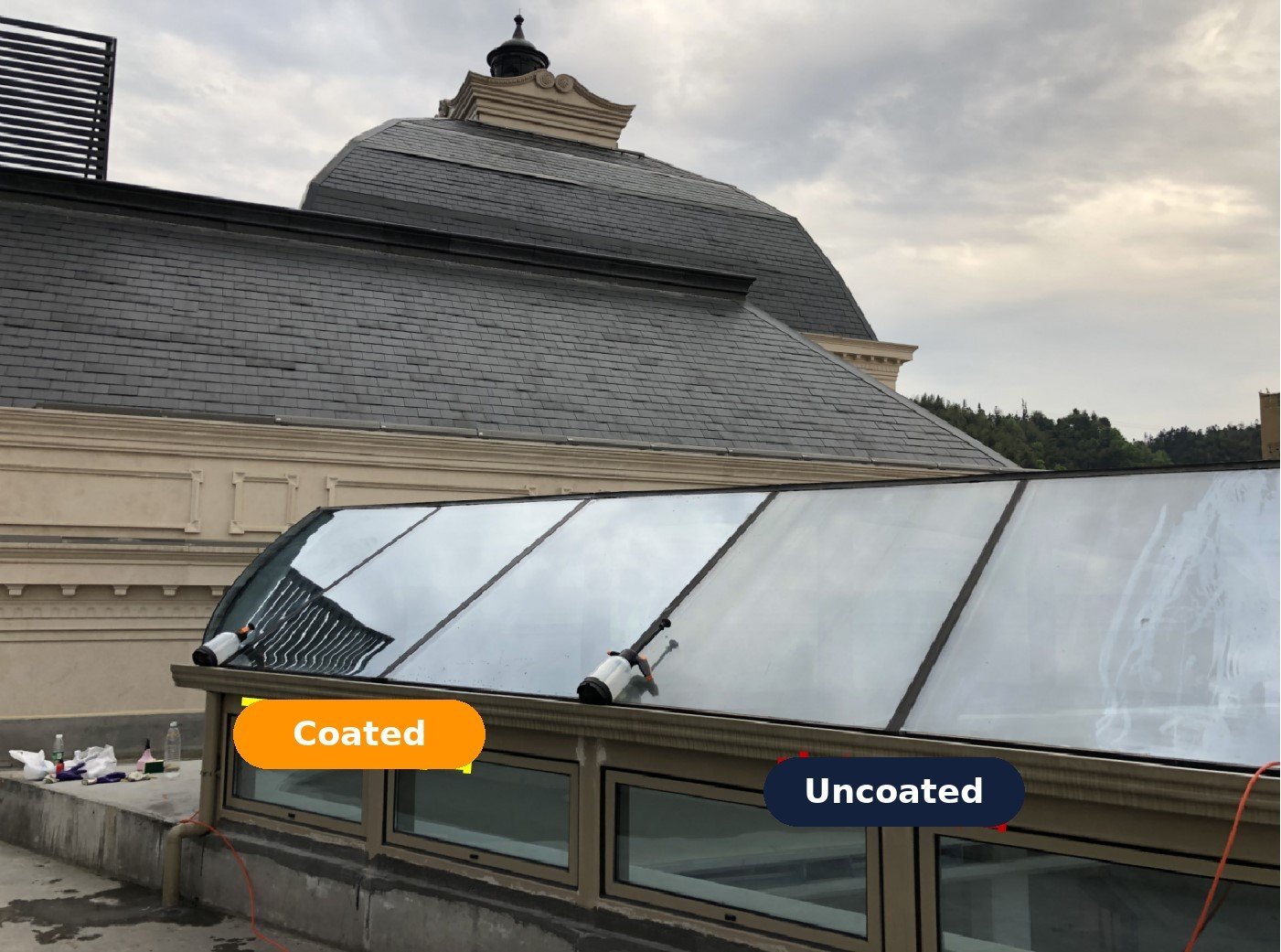
After coating, the anti-static effect keeps dirt from sticking; rain or a plain-water rinse is enough to restore a clean surface. Cleaning becomes far easier and manual cleaning drops by 3/4 per year, saving labour cost.
Industry pain points
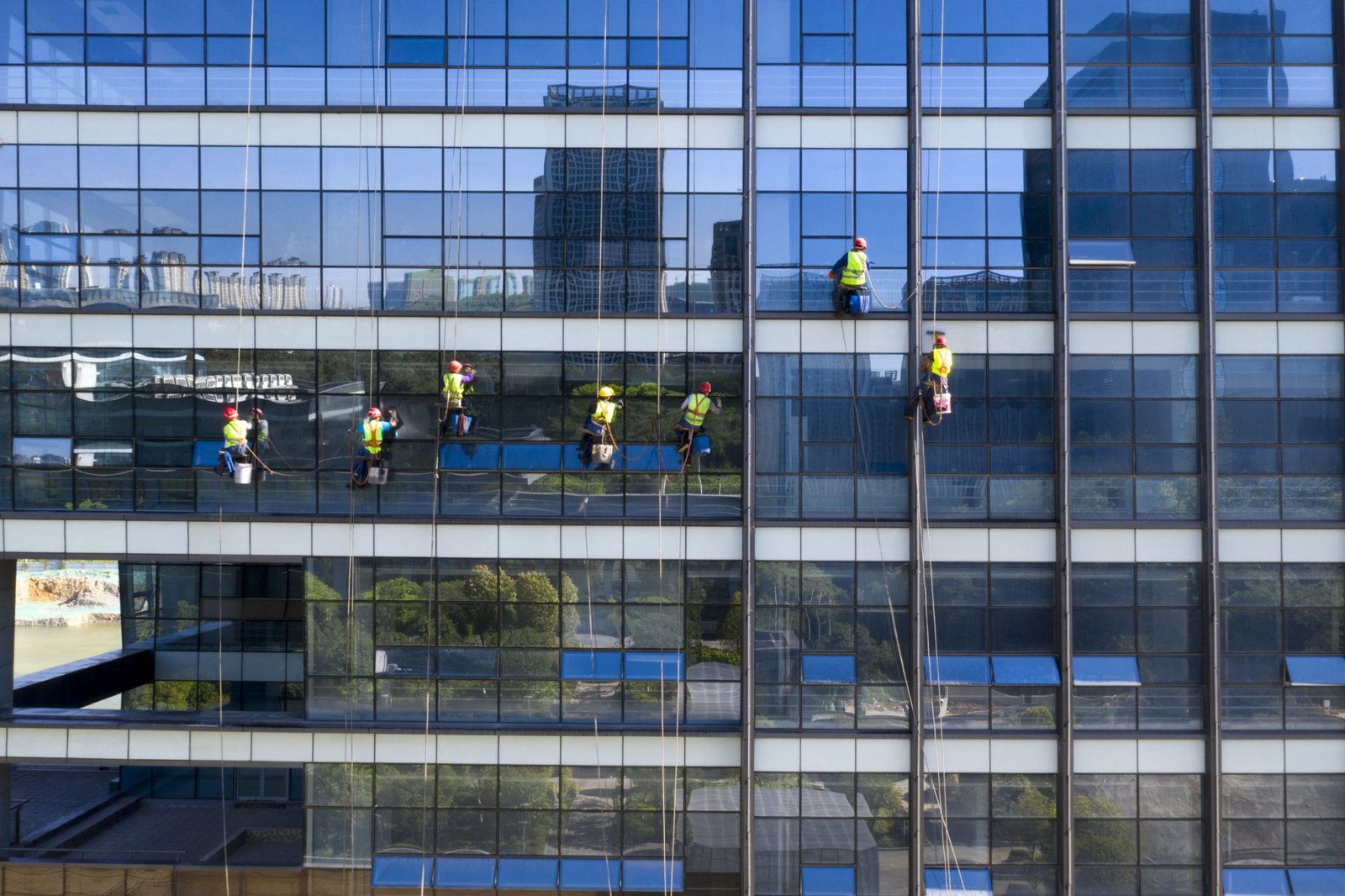
Curtain-wall glass sits outdoors year-round, collecting dust and water marks that spoil the building’s image
High-rise glass cleaning relies on people or equipment — high cost, high safety risk
Conventional cleaning treats the symptom: the glass is dirty again soon after
Frequent cleaning raises long-term O&M cost and management pressure
- Over time this becomes a hidden but significant part of the building’s whole-life cost.
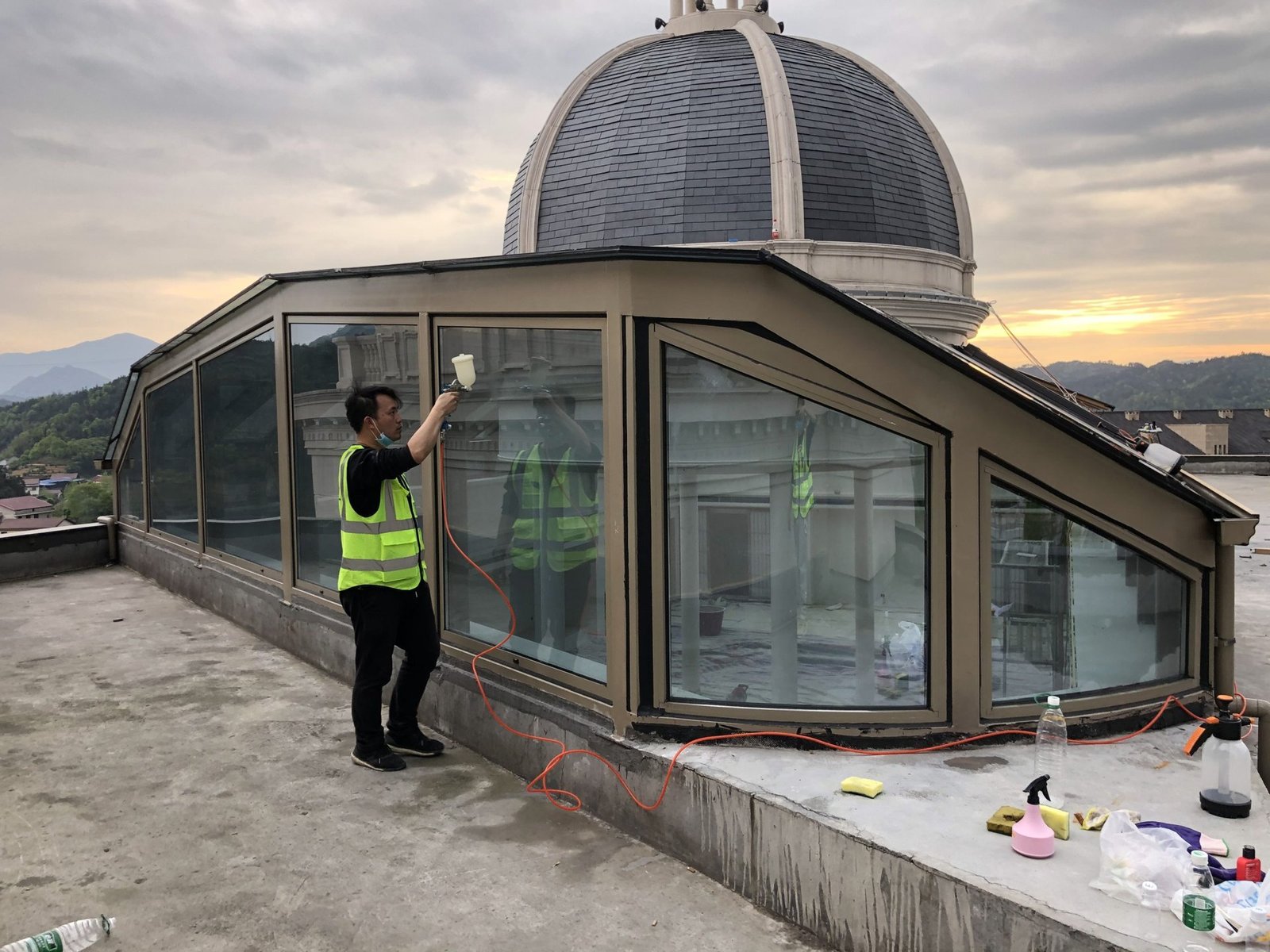
How we apply it
We follow a standardised glass self-cleaning application process so every project delivers the expected performance efficiently and reliably. A typical process:
Site survey and feasibility
Our technical team surveys the site, confirms glass type, mounting and working conditions, assesses environmental factors and prepares the application plan and test plan.
Preliminary cleaning-effect test
Before full-scale application a small test area verifies the glass condition and coating adhesion and confirms the application parameters and expected self-cleaning performance.
Specialist cleaning
The glass is deep-cleaned with neutral detergent and soft tools to remove all dust, oil and water marks, leaving a clean, residue-free surface.
Semi-automatic spray application
Once the glass is fully dry, the self-cleaning coating is applied by spray or wipe, ensuring an even, transparent film that does not affect appearance.
Ambient curing
After application the coating cures naturally at room temperature into a dense, stable self-cleaning functional film firmly bonded to the glass.
Result confirmation and hand-over
The glass is inspected after application to confirm the self-cleaning effect and visual consistency, then the project is accepted and handed over.
Tired of frequent glass cleaning and high maintenance cost?
Feibo nano self-cleaning coating cuts manual cleaning, keeps glass clean and clear long term and lowers work-at-height risk and O&M cost.
Our solution is proven on many buildings and public facilities — get in touch.